
The link between handwashing and health was not established until about 2 centuries ago.
In 1846 Ignaz Semmelweis, a Hungarian doctor regarded as the father of hand hygiene, observed that women giving birth in the medical doctor-run maternity wards were more likely to develop fever and die compared to women giving birth in midwife-run maternity wards.
After careful investigations, he discovered that doctors came straight to maternity wards to conduct deliveries after performing autopsies.
He concluded that doctors carried ‘cadaverous particles’ on their hands to the maternity wards and subsequently led to the fever in the women.
Based on this observation, doctors were mandated to wash their hands with chlorine before conducting deliveries. This practice resulted in a drastic fall in the number of maternal mortalities at the facility.
The Galen theory of Miamas ‘foul odor’ as the cause of disease was the belief during the Crimean War, Florence Nightingale in an effort to wash off the ‘foul odor’ also implemented handwashing protocols which led to the reduction of infections among the wounded soldiers.
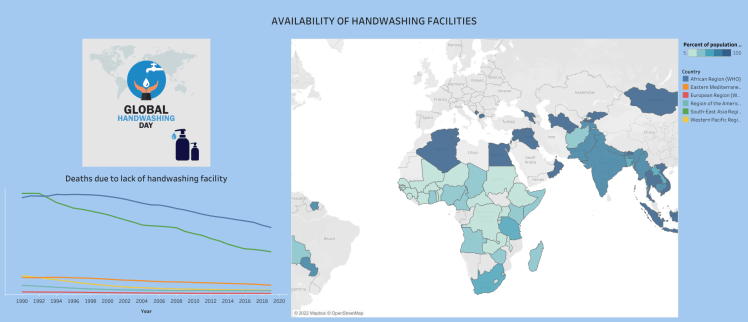
All these were before the Pasteur and Koch’s germ theory of disease. It is unfortunate that even long after the discovery of germs as the cause of disease and the overwhelming evidence of the health benefits of handwashing, there are still some countries especially in Africa where less than 15% of the population have access to handwashing facilities.
The recent COVID pandemic has re-awoken importance of this old but effective preventive public health intervention.
Checkout my dashboard on the access to handwashing facilities and the number of deaths caused by the lack of handwashing facilities https://public.tableau.com/app/profile/ekins.kuuzie/viz/AvailabilityofHandwashingfacilities/Dashboard1?publish=yes.

 Useful Health Statistics
Leave a comment